

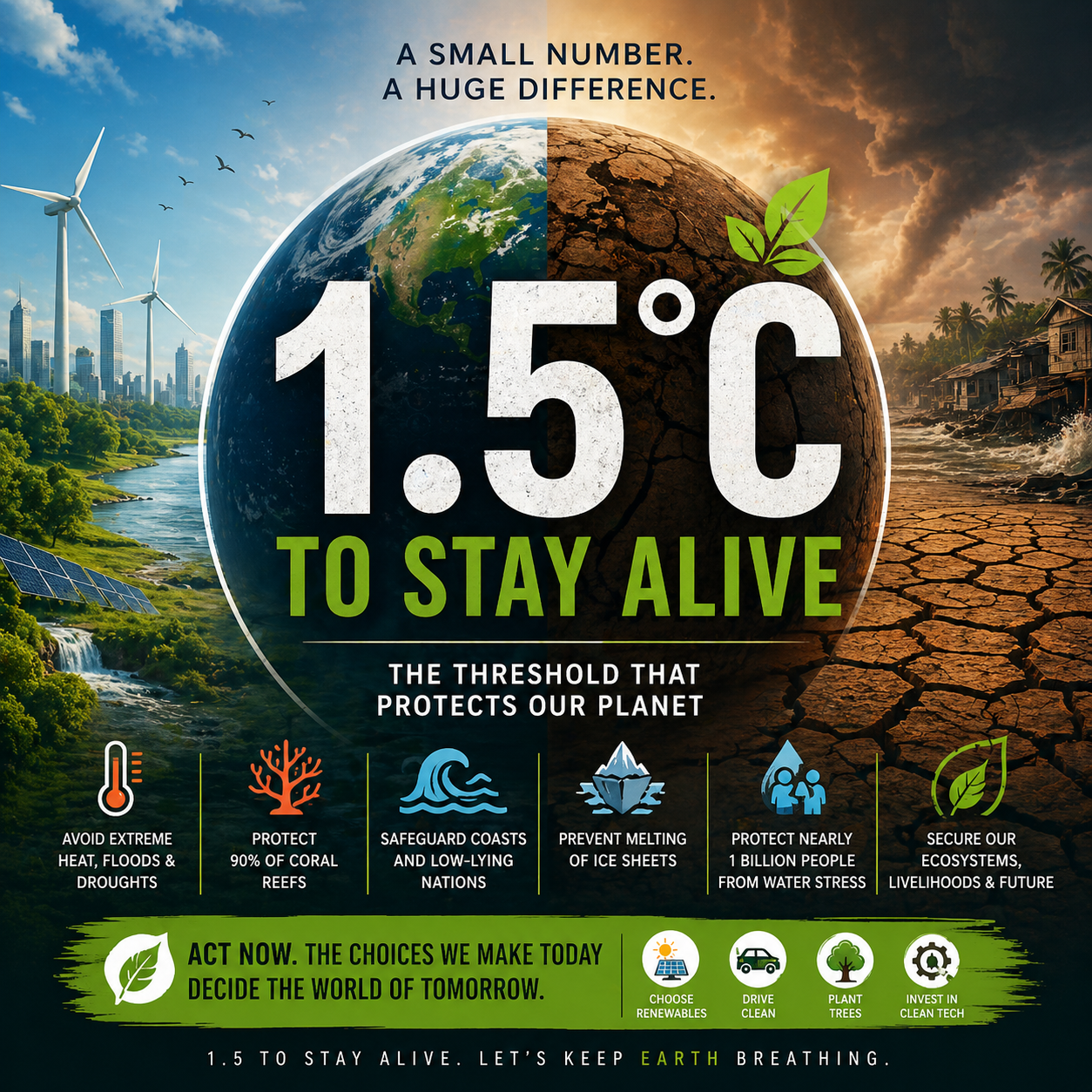
How is this number so significant to the community? What importance can a number really hold? Let me tell you. The 1.5 degree Celsius threshold is a critical global climate goal established by the Paris Agreement 2015 to limit average surface global warming to 1.5 degree Celsius (2.7degree Fahrenheit) above pre industrial levels.
Why the number 1.5?
Scientists actually tried to use 2 degree Celsius as a threshold but found the long term effects were not ideal. Later evidences and research found that 1.5 degree Celsius was preferred. This temperature was established so as to avoid irreversible environmental damage.
Why does 1.5 matter?
This small number actually prevents a lot of damage. If we surpass these levels a lot of irreversible damage could take place such as the collapse of tropical coral reef systems and thawing of boreal permafrost.
Limiting the temperature to 1.5 is crucial for low lying nations (mostly coastal areas such as the Maldives) to avoid catastrophic sea level rise, total habitat loss and coastal erosion. Beyond this threshold over 90% of coral reefs are projected to die, destroying livelihoods and natural protection against storm.
Viola! This threshold also protects us; lower temperatures reduce water stress and decrease malaria expansions.
Impact of exceeding this threshold;
Extreme weather: Increased floods, aggravated heat waves and unbearable droughts will occur.
Marine and Polar: Coral reefs will decline at the rate of 70-80% at 1.5 degree Celsius, coral reefs are an extremely important factor to maintain the balance in the ecosystem, as it is the home to several varieties of fish, squids and octopi. Irreversible melting of Greenland and Antarctica’s ice sheets could be triggered between 1.5 and 2 degree Celsius.
Lives at stake: As mentioned earlier if we surpass these temperatures people in the low lying nations will suffer major setbacks such as floods due to rise in sea levels and loss of habitat due to land erosion. In addition to this nearly 1 billion people could face water stress and desertification.
Economic loss: The 55 most climate-vulnerable economies have already experienced over $500 billion in losses.
What can be done to attain 1.5?
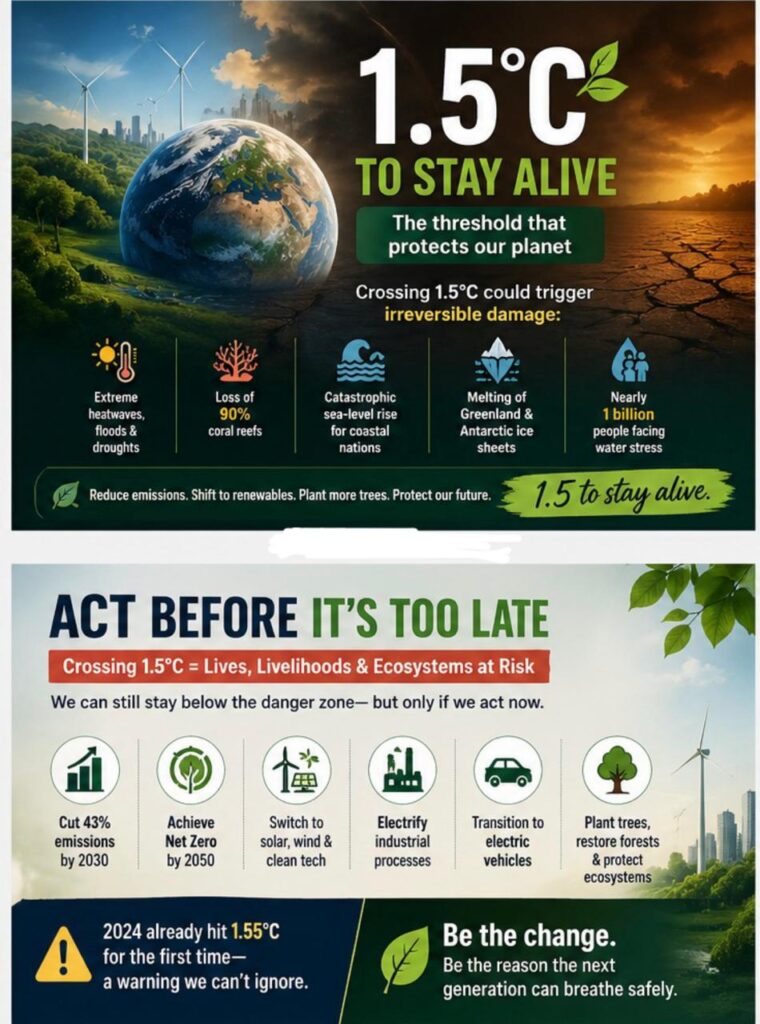
To attain 1.5 carbon emissions have to be reduced by 43% by 2030 and have to be net zero by 2050.
To do that we must shift from fossil fuels to more sustainable energy resources, that is renewable energy resources like solar and wind.
We also have to scale up in carbon dioxide removal and invest in technologies such as bio energy with carbon capture and storage (BECCS) to remove existing Co2 in the air.
Transitioning to electric vehicles and electrify industrial processes so that it is not dependent on oil and gas
The most easy and obvious one on the list which we can all contribute is to plant trees and eradicate deforestation. Restoring ecosystems is also a major plus point.
Accelerating investments in clean technology to promote energy transitions and strengthening national climate plans to ensure they align with the 1.5 degree pathway.
Have we crossed this threshold?
As of this year the world has not crossed the threshold of 1.5 degree Celsius in terms of long-term climate averages, but is has surpassed this limit on a temporary annual basis. The year 2024 was the first calendar year to surpass the temperature 1.5 above pre industrial levels, with global temperatures averaging roughly around 1.55 degree Celsius, but scientists claim that the impact will be graver if the annual rise is long term.
This threshold is a mark, a boundary which we can’t cross. It is what actually keeps us alive, breathing. It’s important that we realize our earth can’t sustain us if we don’t learn to sustain it.
We should be the change, the reason our next generation can breathe safely. There is a slogan that says 1.5 to stay alive and that might as well be something to abide by.
By Arya Saran